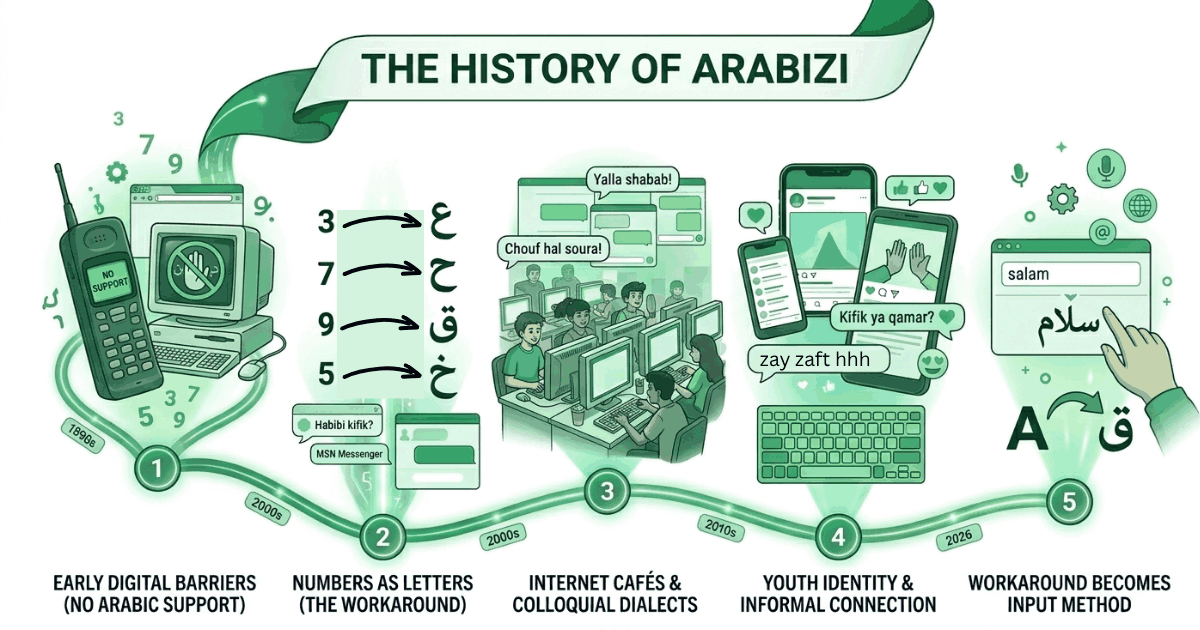
The History of Arabizi: From SMS Limits to Global Chat Culture
How did Arabizi begin? Trace the Arabic chat alphabet from 1990s SMS and internet cafés to today's social media — and why numbers came to stand for letters.
Arabizi — the practice of writing Arabic in Latin letters and numbers — wasn't invented by a committee or a company. It grew organically from a very practical problem: early digital technology couldn't handle Arabic script. This is the story of how a workaround became a global youth culture.
The problem: technology that couldn't speak Arabic
In the 1990s, the digital world ran on the Latin alphabet. Early mobile phones, SMS, pagers, and chat programs like IRC, ICQ, and MSN Messenger frequently didn't support Arabic characters at all. For tens of millions of Arabic speakers, that meant a choice: write in English/French, or find another way.
They found another way.
The workaround: spell it like it sounds
Young people began spelling Arabic words phonetically using the Latin keys they had. Marhaba for مرحبا, habibi for حبيبي. This covered most sounds — but Arabic has several that English simply lacks, like ع, ح, خ, and ق.
The ingenious solution: borrow numbers that look like the missing letters. The numeral 3 mirrors ع, 7 echoes ح, 9 resembles ق, and 5 stands in for خ. With that, every Arabic sound had a Latin-keyboard representation. (We cover the full set in our Arabizi numbers guide.)
The spread: internet cafés and SMS culture
Through the late 1990s and 2000s, Arabizi exploded alongside two trends:
- SMS texting, where character limits and patchy Arabic support made Latin spelling the path of least resistance.
- Internet cafés, where shared computers often had English-only keyboards and software.
Crucially, Arabizi spread across dialects and borders. Because it's phonetic, it naturally captured how people actually spoke — Egyptian, Levantine, Gulf, and Maghrebi colloquial Arabic — rather than formal Modern Standard Arabic. It became the written voice of everyday speech.
The name
The word Arabizi blends Arabi (Arabic) and Englizi (English). Regional names multiplied: Franco-Arabic or "Franco" (especially in Egypt, reflecting French influence), Arabish, and the Arabic Chat Alphabet.
Today: from necessity to choice
Modern devices handle Arabic script perfectly, so the original technical reason for Arabizi is gone. Yet it persists — now by choice. It carries an informal, youthful, intimate tone. It's the texture of texting between friends, memes, and casual social posts.
At the same time, there's a clear shift back toward Arabic script for anything public or professional, because it's standardized, universally readable, and searchable. See our take on Arabic script vs. Arabizi.
A full circle
Tools like Arabizi.io close the loop the history opened. The very phonetic logic people invented to escape Arabic script is now used to generate it: type salam and get سلام. The workaround became an input method. What began as a limitation is now a feature.