Arabizi Numbers Explained: Why 2, 3, 5, 6, 7, 8 and 9 Mean Arabic Letters
A complete chart of Arabizi numbers and the Arabic letters they represent — 3 for ع, 7 for ح, 9 for ق and more — with pronunciation and real examples.
Newcomers to Arabic texting are often puzzled the first time they see a word like 2a5i or 9ahwa. Why are there numbers in the middle of words? The answer is elegant: those numbers stand in for Arabic sounds that have no English letter.
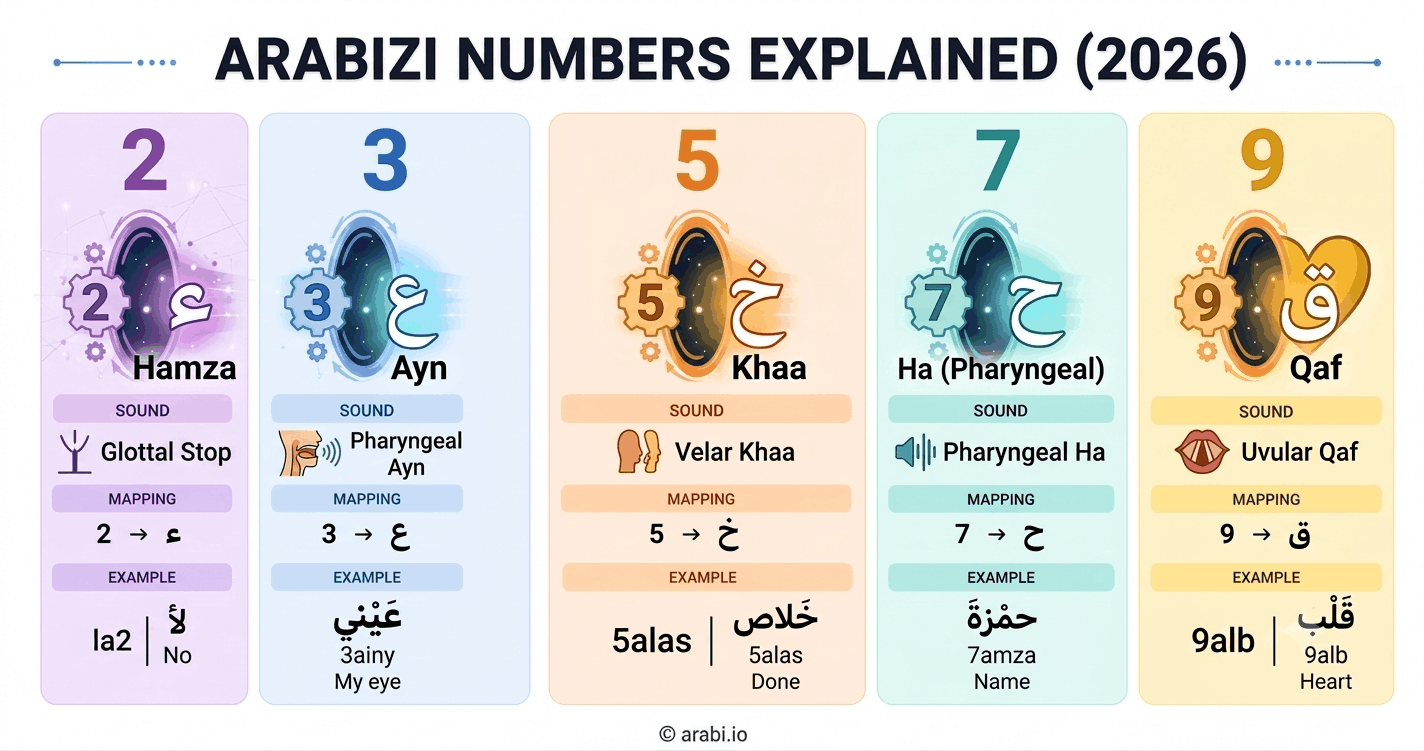
The full Arabizi number chart
| Number | Arabic letter | Name | How it sounds |
|---|---|---|---|
| 2 | ء | hamza | a glottal stop, like the catch in "uh-oh" |
| 3 | ع | ayn | a deep sound from the throat, no English equivalent |
| 5 | خ | kha | like the "ch" in Scottish loch or German Bach |
| 6 | ط | emphatic ta | a heavy, deep "t" |
| 7 | ح | ha | a breathy "h" made deep in the throat |
| 8 | غ | ghayn | like a French/guttural "r" (gargling sound) |
| 9 | ق | qaf | a "k" produced far back in the throat |
A few regional variants you may also see: 6' for ظ, 7' or 5 for خ, and 8 sometimes for ق instead of غ. Spelling isn't standardized, so context matters.
Why numbers instead of letters?
Early phones and chat apps in the late 1990s often couldn't display Arabic script. People needed a way to write sounds like ع and ح that simply don't map to any Latin letter. The clever trick: pick numbers that look like the Arabic letter. The shape of 3 mirrors ع, 7 echoes ح, and 9 resembles ق. Form followed function, and the system stuck. (More in our history of Arabizi.)
Real examples
| Arabizi | Arabic | Meaning |
|---|---|---|
7abibi | حبيبي | my dear |
3arabi | عربي | Arabic |
9alb | قلب | heart |
5ubz | خبز | bread |
2akhi | أخي | my brother |
8ali | غالي | expensive / precious |
6ariq | طريق | road |
Letters vs. numbers: you can often use either
Some sounds can be written as a digraph or a number:
- خ =
khor5 - غ =
ghor8 - ق =
qor9 - ح =
7(or sometimeshin casual use)
A good transliteration engine accepts both. On Arabizi.io, khubz and 5ubz both produce خبز, and qahwa and 9ahwa both produce قهوة — so you can type whichever feels natural.
Don't want to memorize the chart?
You don't have to. Type phonetically and let the tool convert in real time. Open the free Arabic keyboard, turn on transliteration (it's on by default), and type kaif 7alak — you'll instantly get كيف حالك. The number codes, digraphs, and long vowels are all handled for you.