Arabizi Across Dialects: Egyptian Franco, Levantine, Gulf and Moroccan Darija Compared
Arabizi isn't one system. See how Egyptians, Lebanese, Saudis and Moroccans write Arabic in Latin letters differently — which numbers they use, how they spell ق and ج, and the words that give each dialect away.
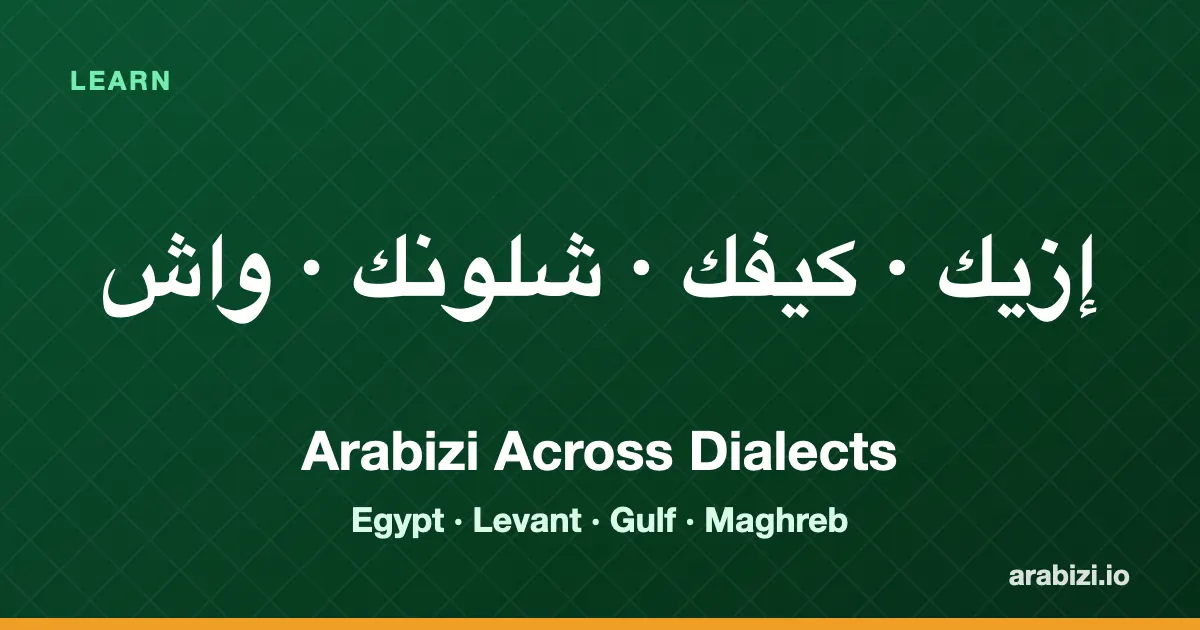
In brief: all Arabizi uses Latin letters plus numbers like 3 (ع) and 7 (ح), but each region bends the system to its pronunciation. Egyptians and Levantines write 2 for ق because they pronounce it as a glottal stop (2albi = قلبي); Gulf writers often use g for ق and 9 for ص (gahwa, 9aba7); Moroccans, Algerians and Tunisians borrow French spellings like ch for ش and ou for و (chokran, mouch). Once you know these patterns, Arabizi from any country becomes easy to read — and our converter handles all of them.
The quick comparison
| Feature | Egyptian | Levantine | Gulf | Maghrebi (Darija) |
|---|---|---|---|---|
| ق written as | 2 (or 9, q) | 2 (or 9, q) | g, 8 (or 9, q) | 9, q |
| ج written as | g (pronounced g) | j | j, (y in some areas) | j |
| ش written as | sh | sh | sh | ch (French) |
| و as a vowel | o, ou | o, u | o, u | ou (French) |
| ص written as | s, S | s, S | 9, s | s |
| ث / ذ | s/t, z/d (in speech) | t, d (in speech) | th, dh | t, d (in speech) |
| Telltale words | ezayak, keda, 3ayez, mafish | kifak, shu, baddi, hala2 | shlonak, wayed, abi, zain | labas, bzaf, daba, wesh |
The ث and ذ row matters because Arabizi follows speech. Many Egyptians say talata (three) rather than thalatha, so they also type talata — even though the word is spelled ثلاثة in Arabic.
Egyptian Arabizi ("Franco")
In Egypt, Arabizi is almost always called Franco (فرانكو), and Egypt is probably its biggest user base. Two pronunciation facts explain most Egyptian spellings:
- ج is pronounced like a hard g, so people type
g:gamil(جميل),gamed(جامد, "awesome"),gam3a(جامعة, "university"). - ق is usually a glottal stop, so it becomes
2:2albi(قلبي),2ahwa(قهوة),2awi(قوي, "very").
| Franco | Arabic | Meaning |
|---|---|---|
ezayak? 3amel eh? | إزيك؟ عامل إيه؟ | How are you? How's it going? |
ana 3ayez 2ahwa | أنا عايز قهوة | I want coffee |
mafish mushkila | مفيش مشكلة | No problem |
keda kwayes awi | كده كويس قوي | That's really good |
Levantine Arabizi (Lebanon, Syria, Jordan, Palestine)
Levantine Arabizi also uses 2 for ق (in cities, where it's a glottal stop), keeps j for ج, and is full of the short words that define the dialect: shu (what), baddi (I want), hala2 (now), kifak (how are you). Lebanese writers in particular mix Arabizi freely with English and French in the same sentence.
| Arabizi | Arabic | Meaning |
|---|---|---|
kifak? ana mni7 | كيفك؟ أنا منيح | How are you? I'm good |
ma ba3ref | ما بعرف | I don't know |
hala2 jayi | هلأ جاي | I'm coming now |
shukran ktir | شكراً كثير | Thanks a lot |
Gulf Arabizi (Saudi Arabia, Kuwait, UAE, Qatar, Bahrain, Oman)
Gulf Arabizi has the most distinctive number habits:
- 9 often means ص, not ق:
9aba7= صباح,9ij= صج ("really", Kuwaiti). - ق is pronounced like a hard g in much of the Gulf, so it's typed
g:gahwa(قهوة),galbi(قلبي). - Dotted variants with an apostrophe are common:
3'= غ,6'= ظ,7'= خ.
| Arabizi | Arabic | Meaning |
|---|---|---|
shlonak? shakhbarak? | شلونك؟ شخبارك؟ | How are you? What's new? |
wayed zain | وايد زين | Very good |
abi gahwa | أبي قهوة | I want coffee |
wain inta? | وين إنت؟ | Where are you? |
Because 9 can mean either ق or ص depending on the writer, context matters. Our engine tries both readings and keeps whichever forms a real word: 9albi → قلبي, 9aba7 → صباح.
Maghrebi Arabizi (Morocco, Algeria, Tunisia)
North African Arabizi shows its French heritage. Writers grew up with French spelling, so:
- ch = ش (
chokran,chkoun= "who"), notsh. - ou = و (
mouch= "not" in Tunisian), as in French vous. - 9 is the usual choice for ق (
9alb), and 3 and 7 are used everywhere. - Short vowels are often dropped entirely:
bzaf(بزاف, "a lot"),mzyan(مزيان, "good").
| Darija | Arabic | Meaning |
|---|---|---|
labas? kidayer? | لاباس؟ كيداير؟ | Are you OK? How are you doing? |
bghit atay | بغيت أتاي | I want tea |
wesh rak? | واش راك؟ | How are you? (Algerian) |
chkoun nta? | شكون نتا؟ | Who are you? |
Tips for reading Arabizi from another country
- If you see
2where you'd expect a consonant, try ق.2alb,2ahwa,2awiare Egyptian or Levantine ق words. - If 9 doesn't make sense as ق, try ص — you're probably reading Gulf Arabizi.
gcan be ج (Egypt) or ق (Gulf).gamilis Egyptian جميل;gahwais Gulf قهوة.- French-looking spellings (ch, ou, é) point to the Maghreb.
- Look for the telltale words in the table above — one
ezayak,kifak,shlonakorlabastells you the dialect.
Converting dialect Arabizi to Arabic script
Most online converters are built around Modern Standard Arabic and stumble on dialect. The Arabizi.io converter combines a dictionary of everyday dialect words from all four regions with a 40,000-word Arabic lexicon, and accepts every regional spelling of ق (q, 9, 2, g, 8). Every example on this page is real output from it. If it picks the wrong reading for an ambiguous word, click the word to choose another. For the technical details, see how Arabizi transliteration works.
Frequently asked questions
What is Franco Arabic?
"Franco" or "Franco-Arabic" is the usual Egyptian name for Arabizi — Arabic written in Latin letters and numbers. The rules are the same as elsewhere, with Egyptian habits like g for ج and 2 for ق.
Is Moroccan Darija written in Arabizi?
Very often, especially on social media and in text messages. Moroccan Arabizi uses French-style spellings (ch, ou) and the numbers 3, 7 and 9.
Why do Gulf Arabs write 9 for ص?
Because 9 resembles ص as much as it resembles ق, and Gulf writers settled on that convention early. Many use g for ق instead, matching its local pronunciation.